Mount Toubkal Express Ascent
Challenge yourself to climb the highest peak in North Africa in 2 or 3 days. The trek starts and finishes in the vibrant city of Marrakech and includes transport to and from Imlil. Trek with a local English-speaking guide, local cook and mules to carry your luggage.
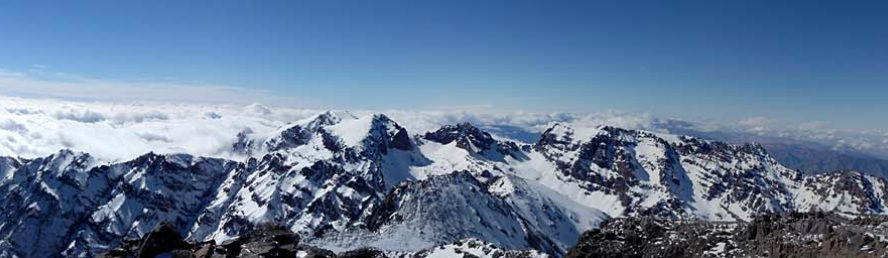
It’s a challenging walk rather than a technical climb, and anyone in good physical condition can reach the summit. Make sure you bring your camera – the views from the summit are spectacular. Mount Toubkal (4,167m) is the highest peak in North Africa and is a trekking peak involving no technical climbing. From November to April, the ascent involves walking in crampons and carrying an ice axe for security.
The itinerary is designed for keen walkers, as the ascent is non-technical but involves some easy scrambling and snow slopes.
This trek runs all year round and can depart on any date of your choice.
We usually have several treks departing each week that you can join if you wish, so please get in touch!
This trek can be booked independently, including transfers from Marrakech, or we can create a full itinerary and quote combining your trek with Marrakech, Essaouira, the Atlantic Coast and the Sahara Desert.
Pick Up & Drop Off
You will be picked up from your accommodation in Marrakech city, many riads don't have access via car so the driver will park nearby and come to get you.
You will be dropped off at the nearest point to your riad/hotel. Our driver can call your riad to meet you if needed.
Route Details
Day 01
Drive from Marrakech to Imlil and trek to Toubkal Refuge
Via Aremd & the Mizane Valley
Leaving the city behind, we drive south towards the craggy peaks and plunging valleys of the Toubkal Massif. Crossing the Haouz Plain, we pass through the small town of Asni, from where the road begins to climb towards the foothills of the Massif. Below us, the Oued Rhirhaia Valley stretches into the distance, while small villages cling to the steep hillsides as we wind our way towards Imlil.
Here we leave our vehicle and, accompanied by our mountain guide, begin our trek along the Mizane Valley, first towards the village of Aremd and then on to the shrine of Sidi Chamarouch. Built on a moraine spur overlooking the valley floor, Aremd is the largest village in the valley and offers an interesting mix of traditional terraced farming, gîtes and streets that seem permanently gridlocked by goats and cattle.
For generations, local Berber villagers have worked these lands, producing maize, potatoes and walnuts from the harsh landscape. Continuing east and crossing the flood plain, our route follows mule tracks and climbs into the high rocky cliffs above the valley. Crossing the river, we eventually reach the pastoral shrine of Sidi Chamarouch, which attracts tourists and pilgrims alike (although only Muslims may cross the stone bridge to visit the marabout shrine itself).
The village sits beside a small waterfall, with a jumble of houses that seem to merge into an anarchic mass. From here, the trail continues to climb steadily, snaking and zigzagging towards the snowline and the Toubkal Refuge (3,206m), our stop for the night. Approx. 5 hours walking.
Day 02
Trek to summit of Jebel Toubkal(4165m); return to Imlil
Jebel Toubkal Summit
Early this morning, we make our attempt on the summit of Jebel Toubkal, the highest peak in North Africa. Our route takes us up the south cirque, crossing the stream above the refuge before heading across one of the mountain’s numerous scree fields, where we negotiate a seemingly endless carpet of boulders and rocks.
The walking is relatively straightforward, but the scree and altitude make the going quite difficult in places. However, the spectacular views along the way make the journey more than worthwhile. Cresting the ridgeline, we find ourselves on the plateau, from where it is a short walk to the summit. The vistas across the surrounding landscape are breathtaking.
From the summit, there are unrestricted views in every direction, from the Marrakech Plain to the High Atlas in the north and as far south as the Anti-Atlas and the Sahara. Pliny, the great Roman scholar, once described the High Atlas Mountains as “the most fabulous mountains in all of Africa”, and from our vantage point high above the valley, it is easy to understand why.
Retracing our steps, we descend the mountain and head back towards Imlil, before driving back to Marrakech.
Note: This itinerary is a guideline and may be changed to suit local conditions.
Equipment
Please ensure you have packed all safety essentials. See the Equipment List here if you're unsure of what to bring. Our guides will conduct a final gear check in Imlil before we commence the ascent to the higher altitudes of the Toubkal massif.

Tour Rates
Flexible Pricing
2-3 people : WINTER 225€/ Person | SUMMER 195€/ Person
4-7 people: WINTER 210 €/ Person | SUMMER 185€/ Person
8 - 14 people : WINTER 185€/ Person | SUMMER 140€/ Person

What Is Included?
-
Expert, Berber, English-speaking mountain guides.
-
Mules and muleteers to carry your luggage.
-
Porters for luggage from snowline to the mountain huts ( Winter months)
-
Berber Cook.
-
All meals on the hike.
-
Accommodation in Berber villages Gites .
-
Round-trip Transportation between the trek and your accommodation in Marrakech
-
Camping Materiel ( Tents & Mattress) for summer treks.
What Is Not Included
-
Travel insurance.
-
Soft/alcoholic drinks
-
Tips and personal expanses
Accommodation & Shelters
Accommodation will be in a dormitory at the mountain refuge.
Camping is also an option if preferred (June–October).
NB: If you require accommodation in the Atlas Mountains before or after your trek, we can arrange a stay at our Dar Adrar Guesthouse in Imlil or our Ouirgane Ecolodge in Ouirgane.


Clothing & Essential Equipment
Essential Equipment
Can Be Hired From Us
-
Good walking boots and socks / good trainers for valley treks
-
Personnel First aid Kit
-
3 to 4 season sleeping bag ( winter) or light Sleeping bag ( Summer)
-
Crampons, Ice axes and Gaiters for Winter treks ( Nov to April )
-
Lightweight waterproof over-trousers / rain-pants
-
Water bottle or camel back (recommended)
-
Soft-sided bag (50-80 litres)
-
Lightweight daypack
-
Sunglasses
-
Sunscreen
-
Torch and batteries
-
Towel & all personal toiletries
-
Crampons : 5 €/ Day/pair
-
Ice Axe : 3 €/day
-
Walking boots : 5 €/day
-
Sleeping bags : 2.5 €/day
-
Rain Jackets : 3 €/day
-
Walking Poles : 3 €/day/pair
-
Back packs : 3€/day
-
Stoves : 2€/day
What Is Appropriate Attire In Morocco?
Morocco is a conservative and religious country, which means you always need to be mindful of your clothing choices. This is especially true in the country’s more rural areas, which include the Sahara Desert and its surrounding villages. As a general rule of thumb, you should always attempt to cover body parts considered “private”. For women, this means covering the arms (or at least the shoulders) and the knees up. For men, it requires covering up the shoulders and above the knee.

High Energy Meals
Meals on the trek are cooked by the Berber muleteers. The food is fresh and healthy. Example meals:
Breakfast: Jam, bread, cookies, fruit, juice, butter, coffee, milkLunch: salad, tomatoes, carrots, lentils, beans, rice or pasta, fish (sardines, tuna), seasonal fruit
Dinner: Soup, classic Morooccan tajine, couscous, olives, nuts, fruit
Can my dietary requirements be catered to?
Absolutely. Just let us know about your catering preferences when you confirm your booking to ensure any dietary requirements are met. Please remind as well your guide and cook on first day of the trek.
Start Your Journey
Ready to explore the Atlas Mountains? Reach out to us for detailed trek inquiries, tailor-made itineraries, or any questions about our Berber-led adventure tours.
Email: aztat.trek@gmail.com
Phone: +212 668-760165
Location: Imlil, Morocco
Personal baggage, cooking equipment and food are carried by the mules, leaving you to carry only a rucksack with whatever you need close at hand for the day. NB: Left luggage or unnecessary luggage can be left safely in our storage in Imlil till you come back from the trek.