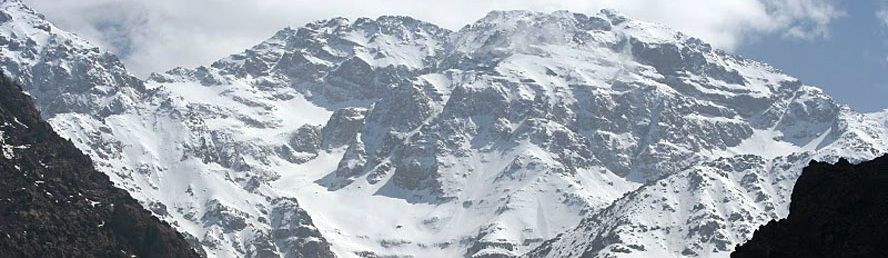
Ascension hivernale du Mont Toubkal
Experience the challenge of climbing Mount Toubkal, the highest peak in North Africa at 4,167m (13,671ft). Enjoy stunning views across the High Atlas Mountains, green valleys and traditional Berber villages as you trek with your local Berber guide and muleteers on an unforgettable mountain adventure.
Mount Toubkal is a trekking peak involving no technical climbing. From November to April, the ascent may involve walking in crampons and carrying an ice axe for security, depending on snow and mountain conditions. The itinerary is designed for keen walkers, as the ascent is non-technical but involves some easy scrambling and snow slopes.
From the summit, enjoy spectacular panoramic views across the High Atlas Mountains, with the Marrakech Plain to the north and the edge of the Sahara to the south. All around you, the jagged peaks of the Atlas stretch into the distance, creating an unforgettable summit experience.
This trek runs throughout the winter season and can depart on any date of your choice. We usually have several treks departing each week that you can join if you wish, so please get in touch!
This trek can be booked independently, including transfers from Marrakech, or we can create a full itinerary and quote combining your trek with Marrakech, Essaouira, the Atlantic Coast and the Sahara Desert.
Pick Up & Drop Off
Vous serez pris en charge depuis votre hébergement dans la ville de Marrakech. De nombreux riads ne sont pas accessibles en voiture, le chauffeur se garera donc à proximité et viendra vous chercher.
Vous serez déposé au point le plus proche de votre riad/hôtel. Notre chauffeur peut appeler votre riad pour venir vous chercher si nécessaire.
Détails de l'itinéraire
Jour 01
Marrakech – Agersioual - Ikkis - Imlil
Depart from Marrakech by car at around 8:00am for a 1 hour 20-minute drive south through the Moulay Brahim Gorges, passing Asni and its weekly market, held every Saturday, before continuing to Agersioual (1,600m), set in the upper foothills of the Western High Atlas Mountains.
Here, you’ll leave the vehicle and meet your local guide before setting out on a 12km trek east towards the Berber village of Aikkiss (1,700m), crossing the Tizi n’Agersioual Pass (2,200m). Lunch will be taken in a Berber home (or beside the river), before continuing up the Imnane Valley and crossing the Tizi n’Tamatert Pass (2,279m).
From here, you can enjoy views across both valleys, looking down into the Imlil Valley and back towards the Imnane Valley. A further 1 hour 30-minute descent will take you to the village of Imlil, where you’ll enjoy an evening meal at a local gîte.
Approx. 1 hour 20 minutes’ driving and 6 hours’ walking.
Day 02
Imlil – Sidi Chamharoush – Refuge du Toubkal
Après le petit-déjeuner, nous commençons notre randonnée le long de la vallée de Mizane, en nous dirigeant d'abord vers le village d'Aremd, puis vers le sanctuaire de Sidi Chamarouch. Construit sur un éperon morainique surplombant le fond de la vallée, Aremd est le plus grand village de la vallée et offre un mélange intéressant d'agriculture en terrasses traditionnelle, de gîtes et de rues qui semblent être en permanence bloquées par les chèvres et le bétail.
Depuis des générations, les villageois berbères locaux travaillent ces terres, produisant du maïs, des pommes de terre et des noix dans ce paysage rude. En continuant vers l'est et en traversant la plaine inondable, notre itinéraire suit des sentiers muletiers et grimpe dans les hautes falaises rocheuses au-dessus de la vallée. En traversant la rivière, nous atteignons finalement le sanctuaire pastoral de Sidi Chamarouch, qui attire aussi bien les touristes que les pèlerins (bien que seuls les musulmans puissent traverser le pont de pierre pour visiter le marabout lui-même).
Le village est situé à côté d'une petite cascade, avec un amas de maisons qui semblent se fondre dans une masse presque anarchique. De là, le sentier continue de monter régulièrement, serpentant et zigzaguant vers la limite des neiges et le refuge du Toubkal (3 206 m), notre étape pour la nuit. Environ 5 heures de marche.
Remarque : Cet itinéraire est une ligne directrice et peut être modifié pour s'adapter aux conditions locales.
Day 03
Trek to summit of Jebel Toubkal(4165m); return to Imlil - Marrakech
Early this morning, we make our attempt on the summit of Jebel Toubkal, the highest peak in North Africa. Our route takes us up the south cirque, crossing the stream above the refuge before heading across one of the mountain’s numerous scree fields, where we negotiate a seemingly endless carpet of boulders and rocks.
The walking is relatively straightforward, but the scree and altitude make the going quite difficult in places. However, the spectacular views along the way make the journey more than worthwhile. Cresting the ridgeline, we find ourselves on the plateau, from where it is a short walk to the summit, with breathtaking vistas across the surrounding landscape.
From the summit, there are unrestricted views in every direction, from the Marrakech Plain to the High Atlas in the north and as far south as the Anti-Atlas and the Sahara. Pliny, the great Roman scholar, once described the High Atlas Mountains as “the most fabulous mountains in all of Africa”, and from our vantage point high above the valley, it is easy to understand why.
Retracing our steps, we descend the mountain and head back towards Imlil before driving back to Marrakech.
Equipment
Please ensure you have packed all safety essentials. See the Equipment List here if you're unsure of what to bring. Our guides will conduct a final gear check in Imlil before we commence the ascent to the higher altitudes of the Toubkal massif.

Tarifs du circuit
Tarification flexible
1 person: WINTER contact us | SUMMER contact us
2 to 3 people: WINTER 275€/ Person | SUMMER 265€/ Person
4 to 7 people: WINTER 260€/ Person | SUMMER 235€/ Person
8 to 14people: WINTER | SUMMER 225/ Person
205€/ Person

Qu'est-ce qui est inclus ?
-
Guides de montagne experts, berbères et anglophones.
-
Mulets et muletiers pour porter vos bagages.
-
Porteurs pour les bagages de la limite des neiges jusqu'aux refuges de montagne (mois d'hiver).
-
Cuisinier berbère.
-
Tous les repas pendant la randonnée.
-
Hébergement dans des gîtes de villages berbères.
-
Transport aller-retour entre le lieu de randonnée et votre hébergement à Marrakech.
-
Matériel de camping (tentes et matelas) pour les randonnées estivales.
Ce qui n'est pas inclus
-
Assurance voyage.
-
Boissons non alcoolisées/alcoolisées
-
Pourboires et dépenses personnelles
Hébergement et abris
1ère nuit : L'hébergement se fera dans une maison d'hôtes confortable et simple à Imlil, telle que la maison d'hôtes Dar Adrar ou similaire.
2ème nuit : L'hébergement se fera en dortoir au refuge de montagne.
Le camping est également une option si vous préférez (juin-octobre).
NB : Si vous avez besoin d'un hébergement dans le Haut Atlas avant ou après votre trek, nous pouvons organiser un séjour dans notre maison d'hôtes Dar Adrar à Imlil ou dans notre écolodge Ouirgane à Ouirgane.


Vêtements et équipement essentiel
Équipement essentiel
Peut être loué chez nous
-
Good walking boots and socks / good trainers for valley treks
-
Personnel First aid Kit
-
3 to 4 season sleeping bag ( winter) or light Sleeping bag ( Summer)
-
Crampons, Ice axes and Gaiters , helmets for Winter treks ( Nov to April )
-
Lightweight waterproof over-trousers / rain-pants
-
Water bottle or camel back (recommended)
-
Soft-sided bag (50-80 litres)
-
Lightweight daypack
-
Sunglasses
-
Sunscreen
-
Torch and batteries
-
Towel & all personal toiletries
-
Crampons : 5 €/ Day/pair
-
Ice Axe : 3 €/day
-
Walking boots : 5 €/day
-
Sleeping bags : 2.5 €/day
-
Rain Jackets : 3 €/day
-
Walking Poles : 3 €/day/pair
-
Back packs : 3€/day
-
Stoves : 2€/day
What Is Appropriate Attire In Morocco?
Morocco is a conservative and religious country, which means you always need to be mindful of your clothing choices. This is especially true in the country’s more rural areas, which include the Sahara Desert and its surrounding villages. As a general rule of thumb, you should always attempt to cover body parts considered “private”. For women, this means covering the arms (or at least the shoulders) and the knees up. For men, it requires covering up the shoulders and above the knee.

Repas énergétiques
Meals on the trek are cooked by the Berber muleteers. The food is fresh and healthy. Example meals:
Breakfast: Jam, bread, cookies, fruit, juice, butter, coffee, milkLunch: salad, tomatoes, carrots, lentils, beans, rice or pasta, fish (sardines, tuna), seasonal fruit
Dinner: Soup, classic Morooccan tajine, couscous, olives, nuts, fruit
Can my dietary requirements be catered to?
Absolutely. Just let us know about your catering preferences when you confirm your booking to ensure any dietary requirements are met. Please remind as well your guide and cook on first day of the trek.
Start Your Journey
Prêt à explorer les montagnes de l'Atlas ? Contactez-nous pour des demandes de renseignements détaillées sur les randonnées, des itinéraires sur mesure ou toute question concernant nos circuits d'aventure guidés par des Berbères.
Email: aztat.trek@gmail.com
Phone: +212 668-760165
Lieu : Imlil, Maroc
Personal baggage, cooking equipment and food are carried by the mules, leaving you to carry only a rucksack with whatever you need close at hand for the day. NB: Left luggage or unnecessary luggage can be left safely in our storage in Imlil till you come back from the trek.