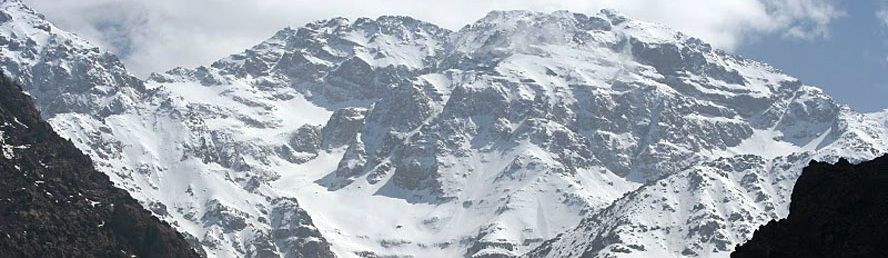
Mount Toubkal Winter Ascent
Experience the challenge of climbing Mount Toubkal, the highest peak in North Africa at 4,167m (13,671ft). Enjoy stunning views across the High Atlas Mountains, green valleys and traditional Berber villages as you trek with your local Berber guide and muleteers on an unforgettable mountain adventure.
Mount Toubkal is a trekking peak involving no technical climbing. From November to April, the ascent may involve walking in crampons and carrying an ice axe for security, depending on snow and mountain conditions. The itinerary is designed for keen walkers, as the ascent is non-technical but involves some easy scrambling and snow slopes.
From the summit, enjoy spectacular panoramic views across the High Atlas Mountains, with the Marrakech Plain to the north and the edge of the Sahara to the south. All around you, the jagged peaks of the Atlas stretch into the distance, creating an unforgettable summit experience.
This trek runs throughout the winter season and can depart on any date of your choice. We usually have several treks departing each week that you can join if you wish, so please get in touch!
This trek can be booked independently, including transfers from Marrakech, or we can create a full itinerary and quote combining your trek with Marrakech, Essaouira, the Atlantic Coast and the Sahara Desert.
Pick Up & Drop Off
Te recogeremos en tu alojamiento en la ciudad de Marrakech; muchos riads no tienen acceso para coches, por lo que el conductor aparcará cerca y vendrá a buscarte.
Te dejaremos en el punto más cercano a tu riad/hotel. Nuestro conductor puede llamar a tu riad para que te recojan si es necesario.
Detalles de la ruta
Día 01
Marrakech – Agersioual - Ikkis - Imlil
Depart from Marrakech by car at around 8:00am for a 1 hour 20-minute drive south through the Moulay Brahim Gorges, passing Asni and its weekly market, held every Saturday, before continuing to Agersioual (1,600m), set in the upper foothills of the Western High Atlas Mountains.
Here, you’ll leave the vehicle and meet your local guide before setting out on a 12km trek east towards the Berber village of Aikkiss (1,700m), crossing the Tizi n’Agersioual Pass (2,200m). Lunch will be taken in a Berber home (or beside the river), before continuing up the Imnane Valley and crossing the Tizi n’Tamatert Pass (2,279m).
From here, you can enjoy views across both valleys, looking down into the Imlil Valley and back towards the Imnane Valley. A further 1 hour 30-minute descent will take you to the village of Imlil, where you’ll enjoy an evening meal at a local gîte.
Approx. 1 hour 20 minutes’ driving and 6 hours’ walking.
Day 02
Imlil – Sidi Chamharoush – Refugio Toubkal
Después del desayuno, comenzamos nuestra caminata a lo largo del valle de Mizane, dirigiéndonos primero hacia el pueblo de Aremd y luego hacia el santuario de Sidi Chamarouch. Construido sobre un espolón de morrena con vistas al fondo del valle, Aremd es el pueblo más grande del valle y ofrece una interesante mezcla de agricultura tradicional en terrazas, casas rurales (gîtes) y calles que parecen estar permanentemente bloqueadas por cabras y ganado.
Durante generaciones, los aldeanos bereberes locales han trabajado estas tierras, produciendo maíz, patatas y nueces en este paisaje difícil. Continuando hacia el este y cruzando la llanura aluvial, nuestra ruta sigue senderos de mulas y asciende hacia los altos acantilados rocosos sobre el valle. Cruzando el río, finalmente llegamos al santuario pastoral de Sidi Chamarouch, que atrae tanto a turistas como a peregrinos (aunque solo los musulmanes pueden cruzar el puente de piedra para visitar el santuario marabú).
El pueblo se asienta junto a una pequeña cascada, con un revoltijo de casas que parecen fusionarse en una masa casi anárquica. Desde aquí, el sendero continúa ascendiendo constantemente, serpenteando y zigzagueando hacia la línea de nieve y el Refugio Toubkal (3.206 m), nuestra parada para pasar la noche. Aprox. 5 horas de caminata.
Nota: Este itinerario es una guía y puede cambiar para adaptarse a las condiciones locales.
Day 03
Trek to summit of Jebel Toubkal(4165m); return to Imlil - Marrakech
Early this morning, we make our attempt on the summit of Jebel Toubkal, the highest peak in North Africa. Our route takes us up the south cirque, crossing the stream above the refuge before heading across one of the mountain’s numerous scree fields, where we negotiate a seemingly endless carpet of boulders and rocks.
The walking is relatively straightforward, but the scree and altitude make the going quite difficult in places. However, the spectacular views along the way make the journey more than worthwhile. Cresting the ridgeline, we find ourselves on the plateau, from where it is a short walk to the summit, with breathtaking vistas across the surrounding landscape.
From the summit, there are unrestricted views in every direction, from the Marrakech Plain to the High Atlas in the north and as far south as the Anti-Atlas and the Sahara. Pliny, the great Roman scholar, once described the High Atlas Mountains as “the most fabulous mountains in all of Africa”, and from our vantage point high above the valley, it is easy to understand why.
Retracing our steps, we descend the mountain and head back towards Imlil before driving back to Marrakech.
Equipo
Por favor, asegúrese de haber empacado todos los elementos esenciales de seguridad. Consulte la Lista de equipo aquí si no está seguro de qué llevar. Nuestros guías realizarán una revisión final del equipo en Imlil antes de comenzar el ascenso a las altitudes más elevadas del macizo del Toubkal.

Tour Rates
Precios flexibles
1 person: WINTER contact us | SUMMER contact us
2 to 3 people: WINTER 275€/ Person | SUMMER 265€/ Person
4 to 7 people: WINTER 260€/ Person | SUMMER 235€/ Person
8 to 14people: WINTER | SUMMER 225/ Person
205€/ Person

What Is Included?
-
Expert, Berber, English-speaking mountain guides.
-
Mules and muleteers to carry your luggage.
-
Porters for luggage from snowline to the mountain huts ( Winter months)
-
Berber Cook.
-
All meals on the hike.
-
Accommodation in Berber villages Gites .
-
Round-trip Transportation between the trek and your accommodation in Marrakech
-
Camping Materiel ( Tents & Mattress) for summer treks.
What Is Not Included
-
Travel insurance.
-
Soft/alcoholic drinks
-
Tips and personal expanses
Accommodation & Shelters
1st Night: Accommodation will be in a comfortable, simple guesthouse in Imlil, such as Dar Adrar Guesthouse or similar.
2nd Night: Accommodation will be in a dormitory at the mountain refuge.
Camping is also an option if preferred (June–October).
NB: If you require accommodation in the Atlas Mountains before or after your trek, we can arrange a stay at our Dar Adrar Guesthouse in Imlil or our Ouirgane Ecolodge in Ouirgane.


Clothing & Essential Equipment
Essential Equipment
Can Be Hired From Us
-
Good walking boots and socks / good trainers for valley treks
-
Personnel First aid Kit
-
3 to 4 season sleeping bag ( winter) or light Sleeping bag ( Summer)
-
Crampons, Ice axes and Gaiters , helmets for Winter treks ( Nov to April )
-
Lightweight waterproof over-trousers / rain-pants
-
Water bottle or camel back (recommended)
-
Soft-sided bag (50-80 litres)
-
Lightweight daypack
-
Sunglasses
-
Sunscreen
-
Torch and batteries
-
Towel & all personal toiletries
-
Crampons : 5 €/ Day/pair
-
Ice Axe : 3 €/day
-
Walking boots : 5 €/day
-
Sleeping bags : 2.5 €/day
-
Rain Jackets : 3 €/day
-
Walking Poles : 3 €/day/pair
-
Back packs : 3€/day
-
Stoves : 2€/day
What Is Appropriate Attire In Morocco?
Morocco is a conservative and religious country, which means you always need to be mindful of your clothing choices. This is especially true in the country’s more rural areas, which include the Sahara Desert and its surrounding villages. As a general rule of thumb, you should always attempt to cover body parts considered “private”. For women, this means covering the arms (or at least the shoulders) and the knees up. For men, it requires covering up the shoulders and above the knee.

High Energy Meals
Meals on the trek are cooked by the Berber muleteers. The food is fresh and healthy. Example meals:
Breakfast: Jam, bread, cookies, fruit, juice, butter, coffee, milkLunch: salad, tomatoes, carrots, lentils, beans, rice or pasta, fish (sardines, tuna), seasonal fruit
Dinner: Soup, classic Morooccan tajine, couscous, olives, nuts, fruit
Can my dietary requirements be catered to?
Absolutely. Just let us know about your catering preferences when you confirm your booking to ensure any dietary requirements are met. Please remind as well your guide and cook on first day of the trek.
Start Your Journey
Ready to explore the Atlas Mountains? Reach out to us for detailed trek inquiries, tailor-made itineraries, or any questions about our Berber-led adventure tours.
Email: aztat.trek@gmail.com
Phone: +212 668-760165
Location: Imlil, Morocco
Personal baggage, cooking equipment and food are carried by the mules, leaving you to carry only a rucksack with whatever you need close at hand for the day. NB: Left luggage or unnecessary luggage can be left safely in our storage in Imlil till you come back from the trek.